
Welcome to the first installment of the Blood Milk Book Club: 'The Vorrh' by B. Catling.
As I've mentioned before, I'm absolutely winging this, it is completely experimental but something I feel dedicated to and passionate about, and sometimes, despite the small messes you can make when starting something without having a recipe in hand, things unravel and smooth out over time if you burn for it. So here goes:
When I was in graduate school, one of the first courses I took was Shelley Jackson's Non-Linear class. We read odd books; I was both bored by some of the gimmicks and stimulated by the writers who fared better at digressions. B. Catling is one of those writers who is successful at digressions. He is also brilliant at carrying the heavy weights of a large cast of characters and sub-species within a fantastical setting. ( The hefty Game of Thrones books are also mostly successful with this same balancing act. )
There is talk about how fantasy based / weird / cosmic horror / speculative fiction will be taken more seriously and will be penned by more contemporary writers in the present and future tenses as it allows people to explore psychic / psychological situations with an escape of realism ( i.e. the exploding success of Karen Russell into the main stream.) Which quickens my blood because it has always been my favorite way to read and write. Anything that transports me wholly from my life and internal landscape's sounds/moods/repetitions is for me. Books as escape hatches always. Which was precisely what 'The Vorrh' offered, an entrance into a world forged with truly original imaginative thinking & beautifully sculpted language / sentences.
Here are some ideas that snared me:
* The night seems to take on another texture. When traveling into 'The Vorrh', 'Night' last upwards of 40 hours, or feels like it does anyway. The darkness is 'perfumed', it is riddled with strange creatures that may be blood thirsty, it is an ominous black tablet painted with layers of darknesses.
Charlotte's descriptions of the Twilight Dove and the Twilight Raven seem to be metaphors for these differences in light/darkness.
This technique lends itself to other disorienting elements in the book. It's hard to know the exact landscape of the forest and where the travelers are inside of it. It seems more like a vortex; the memory draining and The Orm's hollowing techniques are quite frightful. This contrast of beauty and terror is exactly the kind of thing that works sharp hooks into me.
* Despite depictions of monstrous cruelty, graphic violence ( there are many murders and strange deaths woven like a dark thread through the skin of the book) and taboo subjects (the one who looks back), there is a realistic and comforting view of love and friendship found in so many of the criss crossings of characters. Even when Ishmael forgoes his ghostly friendship for his lover, I believed. Sometimes friendships are apparitions, materializing in and out of your life. Other times our relationships run deeper and we sacrifice for them.
* Although I enjoyed the passages on Muybridge, (some of which were my favorite in the book) he's the only person who hasn't directly been inside the Vorrh ( although it appears he's traversed every other heart of darkness) or knowingly been in direct contact with anyone who has travelled inside it. He's a historical figure with his own 'real' baggage and yet is given a new life under Catling's pen. He exists outside of the intersecting narratives. I did however, get excited when Sarah Winchester showed up. I love the Winchester Mystery House. Its one of those structures I feel deeply drawn to.
I loved this bit from his story line 'Muybridge was vividly reminded of a photograph he never stopped to take...' This stayed with me and lent itself to the arching narrative of memory within. How some of the character's memories are sharp and intact, while others are erased and fogged, and yet still others, like the rest of us, have a more shifting relationship with our memories.
* I was interested in the many spiritual traditions at play. They were numerous and yet, it is said that Eden lies at the center (which we are never made clear if Peter Williams has made it to or not.) Catling was not heavy handed with the Bible here and Adam is actually struck down more easily than I imagined possible. Charms, spells, potions, prayers, tests of faith, and healing rituals are all a beautiful cocktail in this world, operating side by side. I was interested in how well Catling was able to describe and balance these different ideas, some of which were not even wholly understood or flushed out, but still succeeded. (thinking of the Limboia in particular here and their strange mirror ritual.)
*Lastly, though I could go on & hope to in the comments: I really enjoyed all of the descriptions of bodies and feel this is one of Catling's most poignant strengths, which may stem from him also being a visual and performance artist as well. We may not always be rooted in a particular place, more levitating over it, but his bodily imaginings make me feel tethered to this world he's created. The Kin have bodies that are described as 'hard and beetle like' while their innards seem to be made of a kind of thick spider silk cream. Ishmael's body and sexual organs are graphically described and even in his self-imposed transformation to look more normal, he still comes across as beautiful and gentle to me. By the end, 'his life is his to live' and I'll be curious to see how he fares in upcoming installments. The Erstwhile also have transformed bodies that can't be perceived by the human eye, but once they are burned, their bones are more tangible. I can go on and on here: 'a zoo of measured humanity.' A line that may yet be the heart of the story at hand.
Synchroncity I found personally pleasing:
In Alan Moore's glowing review of the book, he describes it as akin to Max Ernst's collage work.
Muybridge's work is prominent in a Laird Barron story, 'The Hand of Glory.'
So, what were your thoughts ?
Please remember I moderate comments to avoid strange spam so if yours doesn't show up right away, please be patient !
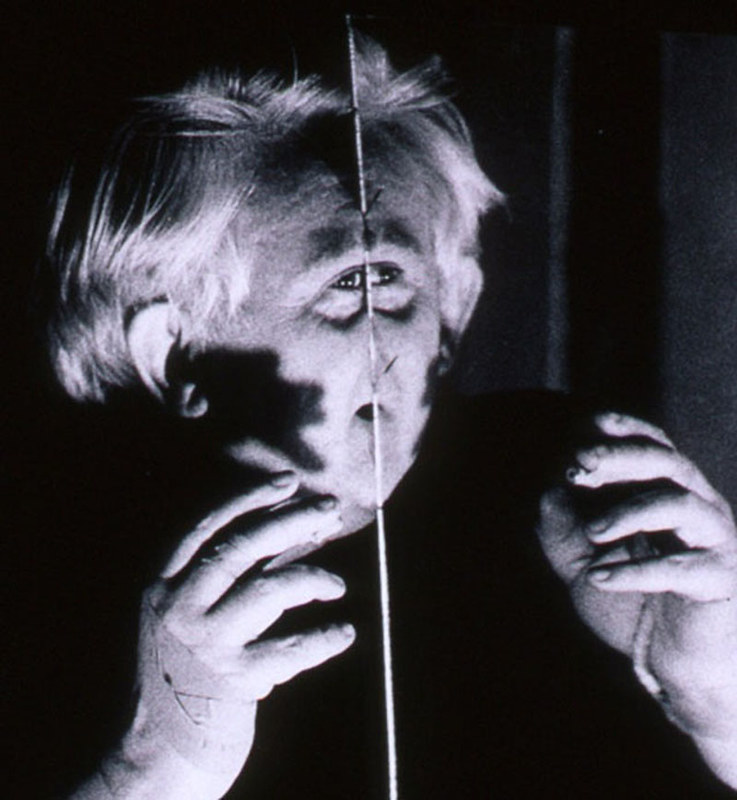
*image of the author as a cyclops*

